maker faire vs toastmasters – co-running an event

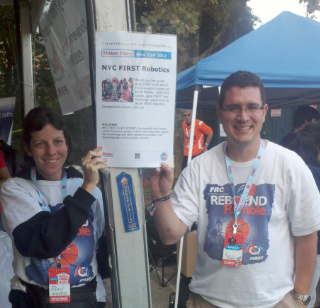
Over the past week and a half, I co-ran two events.  One was the NYC FIRST robotics booth at Maker Faire (see picture.) The other was an area contest for Toastmasters.
Since these two events were so close to each other, I spent some time comparing my experience.

Overview of event

Maker Faire: Norm Sutaria and I have run the NYC FIRST robotics booth at Maker Faire for the past three years.  Our booth is 20 x 30 feet and we coordinate robotics teams from elementary school through high school to show their robots.

Toastmasters contest: Toastmasters holds speech contests where contestants from multiple clubs square off.  Since our area only has four clubs, I ran the contest with another area governor to make it a bigger event.

Ribbon

Our booth won an editors choice award at Maker Faire.  That is really cool and exciting.  Toastmasters gives ribbons out for every speech and certificates of appreciation for helping at a contest.  I don’t find these motivating because you get them frequently regardless of whether you did a good job.  The Maker Faire ribbon actually feels special.  I don’t know how many were given out, but we didn’t win it the last two years making it special for us!

Delegating

For Maker Faire, Norm and I get to practice delegating.  Both to each other – play to the other person’s strengths – and to the teams.  We are both good at delegating to students and not trying to do everything ourselves.  For planning, it was more of claiming the work we wanted to do or were best at rather than delegating.  There was some level of needing to trust the other person at the event though.  It’s important to eat and take breaks knowing the other is in charge!  And for me, remembering to ask for help lifting things when I need to and not worrying about not “pulling my weight” in that specific area.  I do lots of other things!

For Toastmasters, we split planning by event.  I did the lions share of the planning/organizing/running this time and the other area governor will this time.  As a result, less delegating went on.  There was some of course since a contest has a number of contest officials.  And I did seek volunteers for certain parts.

Contingency planning

The first two years, our Maker Faire rain plan was “it better not rain.”  This year, rain was likely so we came up with an actual rain plan.  We announced it both mornings and used it Sunday.  (The plan was to cover up the electronics with tarp and painters plastic, have some students under the tent and encourage most to go into the Hall of Science.)

For Toastmasters, I thought about things likely to go wrong and had an extra judge on hand along with a plan for how to get more if needed.  For the most part, it was “figure out how to run with it” if things went wrong.  Which worked out just fine.  I think this is because a Toastmasters speech contest is a lot more predictable.

Interestingly, this shows a difference between volunteer work and paid work.  In the business world, I don’t typically plan to wing it if something goes wrong!

Google forms

On the tech side, I used Google forms to organize both events.  For attendance lists in both cases and collecting data, listing teams, etc for Maker Faire.

Where I grew the most

Both FIRST robotics and Toastmasters help with soft skills and leadership skills.  Toastmasters does it more obviously – it is in their mission.  FIRST robotics “tricks” students into learning about teamwork and leadership through the “distraction” of a robot.  Does it for the mentors too!  I definitely stretch myself and learn the most at the Maker Faire event.  Partially because I talk to a lot of people I don’t know and give the “FIRST pitch.”  Partially because running the booth is a lot more work.  And partially because a public event is a lot less predictable than a Toastmasters contest.

Both work though.  Because if you tell a techie he/she will spend a weekend practice soft skills, you aren’t likely to get a good reaction.  Throw in robots or the need to get something done and it changes the picture completely.
new samsung tv

I bought a new HDTV/computer monitor.  I’m only using it as a TV, but they brand it as both.  Which is good as I can easily use it as a second monitor if I want to.  I went to B & H to see it in person before I bought it.  I like seeing electronics in the store.  The TV came well wrapped a few days later.

The missing manual

Setting it up was easy.  However, there was no manual.  Instead there was a CD which I imagine has the manual on it.  I say I imagine because the CD can only be used on Windows.  While I haven’t gotten rid of or given away my old Windows laptop, I don’t particularly want to take it out to open this CD.  The manual was downloadable via a PDF online.  I printed it and now have a printed manual.  Now I’ll grant you they saved paper not shipping a manual.  But there was plenty of other paper junk in the box.

The devices I actually use

All the devices a normally plug into the TV work fine.  It’s my first HDTV so I still need to plug in the HD cable from Time Warner.  I’m sure that is easy.

Over the air tv

I own a standalone antenna and digital converter box so I can provide tech support  for those to devices to family.  I’m considering upgrading said family’s tv so I decided to try out over the air tv to see what happened.

  1. With the cable box still plugged in, I scanned for over the air channels.  Three channels were found.  One of which came in poorly.  And one of which was displaying FOX on a channel number that should have been NBC.  None of the three channels came in well (analog fuzziness) and none of them had sound.
  2. I read online and tried changing a number of settings.  None worked.
  3. I emailed Samsung who suggested I check my connections.
  4. Then it occurred to me to try the standalone antenna.  I unplugged the cable box, plugged in the antenna and tried again.  (I do own an a/b switch letting me use both, but I’m not leaving the antenna plugged in long so it is easier to switch out.)  I have 47 channels over the air!  All of which come in decently to well.  For those who haven’t used over the air tv since before the digital cutover, each station can broadcast more channels now so there is a 2-1, 2-2, etc.

Is it worth having cable?

Probably not.  Now that over the air comes in, I imagine buying tv shows individually over hulu and watching streaming for events is more cost effective.  That would require faster internet though so I’ll revisit it when FIOS comes to town.  (Opportunity here for Scott to tease me about Tivo or Apple TV.)

Why did reception suddenly get better?

I have two things that changed.

  1. The new TV that doesn’t require a digital converter box.
  2. I moved since I last tried to watch over the air tv. (when the cable went out a few years ago.)  I suspect this is more significant as the current location of the antenna faces Manhattan – where broadcasting comes from.  Before I moved, it didn’t.

I was under the impression the HDTV had an internal tv tuner.  Not sure if it as an antenna, but probably not.  That explains why plugging in the antenna helped.

I tried my old tv with the external antenna and digital converter box.  The reception was good as well implying it is my new location more than the tv that helped.

trying architexa – an eclipse diagramming plugin

Architexa recently announced free licensing for individuals or teams of up to three.  I figured I’d run it against CodeRanch JForum to see what happens.

Requirements/Install

The software is an Eclipse plugin.  You get the link after registering.  A different update site is provided for Eclipse 3.X vs Juno (4.2).  I know some CodeRanch JForum developers use IntelliJ IDEA.  I don’t, so I can try it out.  The install was smooth.  I did get asked to confirm I trust the certificate within Eclipse.

One minor discrepancy.  The website says the software is free for individuals and teams of up to three developers.  The email confirming your email and welcoming you says the software is free for individuals and teams of up to four developers.  Moot point at the moment since I’m using it as an individual.  But Architexa should sync these up.

The email asks me to validate my email using a localhost link.  Same for editing my profile.  I can’t click on it to validate.  Hm.. I then went to the website and clicked the “forgot password” link.  This got an emailed password which I could use to validate in Eclipse itself.  Again the change password link is a localhost link.  After entering that password, Eclipse said my account was validated.  So while the links are broken, I’m in the tool.

Learning curve

Architexa asks which projects it should index.  I said just JForum.  Architexa provides good Eclipse “cheat sheets” to start out quickly.

Layered Diagram

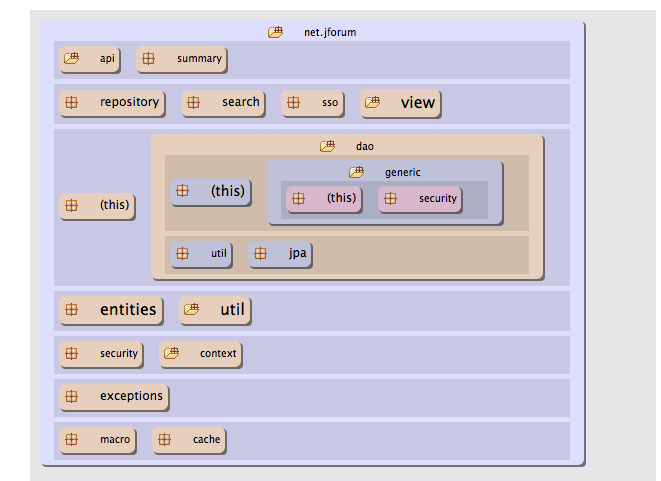
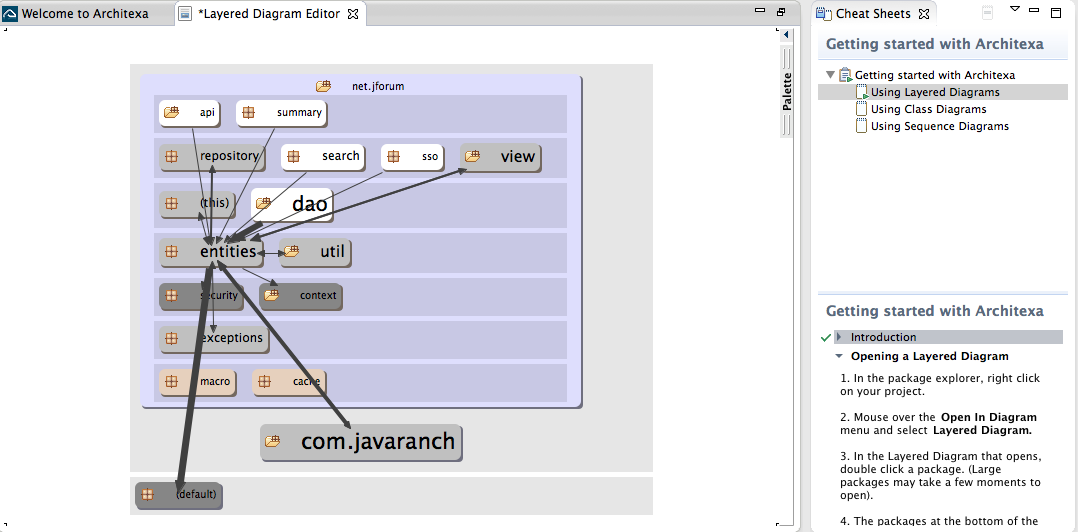
This is like a dependency graph for packages.  Very nice.  If you mouse over, you see incoming (afferent) and outgoing (efferent) dependencies.  You can also drill down to see lower level packages.

Class Diagram

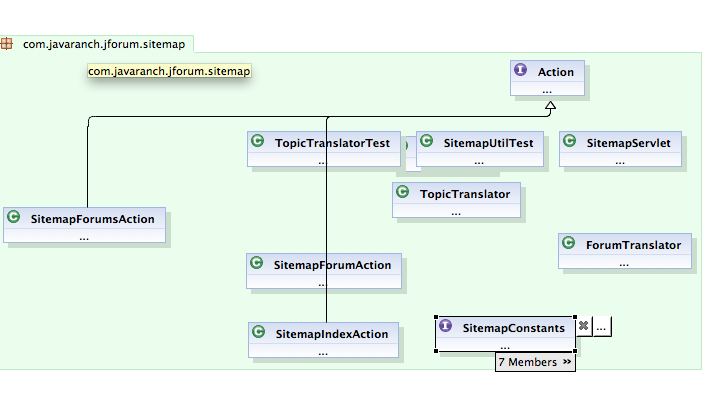
Right clicking a package opens the option to create a class diagram.  Two classes generated on top of each other, but I can drag them around (or highlight them or call other attention.)  It is easy to view the source code from the class diagram.  I don’t see how to view the method names/fields in the class diagram.  This info is available in the outline view in Eclipse already though so it isn’t critical.

Sequence Diagram

This appears to be an enhanced editor.  You drag classes into it and it shows calls.  This seems like more work to create.  I tried dragging a few items over and “add all” to get the calls.  Unfortunately calls aren’t so much within one or two classes so this didn’t help much.  I didn’t create anything worth taking a screenshot of.

Overall opinion

The package diagram caught my attention the most.  I really like the dependency arrows.  The class diagram provides a nice visualization as well.  The sequence diagram seems like it would be a good documentation aid if one was creating sequence diagrams for the project.  Which I’m not because we inherited the design of the code and I’m already familiar with the flow.  I think more value would come from sharing documents and using the tool as a team.

For a “real” (paid) project, I”m not sure I’d be so thrilled to keep my documentation in a proprietary tool. Even a free one.  But for getting a feel for the software on a product that is “documentation-lite” or “no documentation”, the layered (package) diagrams and class diagrams provide a nice way to jump in.  Assuming you are using Eclipse already of course.