
Starting a voluntary discussion group

I co-founded a lunchtime discussion group at work five years ago.  As we approach the fifth anniversary, I was reflecting on what went into it.  What worked; what didn’t; what would I do differently.  Our purpose was to have a place to discuss technology that we weren’t necessarily working on and to share knowledge/ideas across teams/departments.

Background

Technically the group started more than five years ago as a technical book club.  That didn’t work because everyone had to read from the same book.  Which requires preparation each meeting.  It also makes it hard to come back after you’ve missed a meeting.  The organizer of that group and I had an informal conversation near the cafeteria hallway about how to improve things and the new group was born!

The new group

We started meeting twice a month and switched to once a month over time.  We have a mix of moderated discussion topics and presentations with heavy Q & A.  At the beginning, we said we would cancel the meeting if there weren’t 4 people in the room.  This hasn’t been a problem in years.

What I consider key to the group’s success

  • We always meet the same day and time – this makes it easy for people to remember when the group meets.  For example, the first Tuesday of the month; the first and third Thursday of the month, etc.
  • Advertising – We advertise through an opt-in mailing list (don’t spam people), telling people who might be interested and putting up physical signs the day of the meeting.  Speaking of which these signs are always the same color/font/logo to encourage branding/memory.  People have even said “you are the blue sign people”.
  • Voluntary – This one is important to me.  Attending the group is voluntary.  Running the group is voluntary.  This means it is not a work thing and does not get billed to work projects.  It also allows the group to remain independent topic wise and FUN.
  • Informal – While we do have presentations, they are usually of an informal type. (Sometimes someone is previewing a formal presentation.)  Again, this is in keeping with the goal of things being FUN.
  • Size of group – We haven’t had problems with the size of the group per se.  We get between 6 and 20 people most months which is a good size.  We’ve been asked about including other offices in other states in the group.  We do have a phone bridge for people within the company and have invited people from one or two other offices on occasion recently.  And this is fine if it is small.  If there are too many from too many offices, it changes the spirit of the group.  And there are already company wide information exchange type groups in place.  This particular item is something we are going to have to monitor so we don’t become victims of our own success and lose the benefits of a New York based group.
  • Varying formats – Having a mix of presentations and moderated discussion has served us well.  Presentations are good when someone has a lot of experience with a technology.  (or can throw something together on it.)  Moderated discussion is good when multiple people have lots of small thoughts.  And the moderator doesn’t have to be an expert.  Just like at JavaRanch where I moderate the BlackBerry forum without knowing anything about BlackBerry development.  Whenever I moderate at the discussion group, I come with a list of questions/talking points.
  • Hook to real work topics – Most of the time topics involve technologies or emerging technologies someone in the company is working on.  Or planning to work on.  Or a cross cutting concern like performance.
  • Range of topics – You’ll notice I said most of the time.  Some of our topics have nothing to do with work.  There’s that FUN thing again.  We also select topics based on what attendees want to hear.
  • Emphasis on interactiveness – While we do have people who just sit and listen, most participants are actively engaged.  This keeps a good dynamic, keeps in informal and keeps it FUN.
  • Different moderators – Trying to have as wide a range of people moderate as possible is helpful.  It gives the group a changing voice.  It helps more people feel invested in the group.  And it gives people a chance to practice leading.
  • Group leaders changing over time – We have had 5 different people co-lead the group at different points it time.  (Co-leaders are good because it is less work and you don’t have to worry about vacations.)  One person left the company.  And two others (including myself) stepped down from actively running the group after getting job responsibilities that would have compromised the informal appearance of the group.  The two of us still attend/moderate and are plenty involved.  But we don’t run it or give the opening/closing remarks anymore.
  • Topic control – I mentioned we are an informal group.  This gives a stronger ability to decline topics.  At times, people from outside the group come to us with ideas.  Some are good ideas and we use them.  Some are “good ideas that don’t fit.”  (There’s no such thing as a bad idea; we like ideas; that’s how brainstorming happens.)  Being able to decline these ideas keeps the group FUN and interesting.

What to think about if starting your own discussion group?

  1. What is your goal?– Knowing what your goal/vision is for the group helps you set it up in a way conclusive to what you want to accomplish.  It also tells you who to advertise your group to.
  2. Do you want it to be official or unofficial?– Both are valid options.  They have different tones/topics/styles and deciding which you have is important.  (Incidentally, the reason I stepped down from running this group is because I became involved with an official one.)
  3. Do you want it to be voluntary or mandatory? – Even an official group is hard to make mandatory.  Beware of this option.
  4. When is good to meet?– Think about when meetings are generally scheduled in your company.  It is ok to change this until you stabilize.  But then try to stick to the same date/time.
  5. What is a good group size?– What is your target?  Is there a number that is too high or too low?
  6. How do you gain critical mass? – It’s much easier to run a group than to start one.  Think about what you can do to get people to come to your first few meetings.

Summary

I used the word FUN a lot in this post.  That’s really the vision for this group.  Good techies are passionate about technology.  While that doesn’t always come out amidst business activities, our group is an opportunity to channel that pure FUN for what we do.

If you tried Subversive before, it’s time to try it again

Helios’ Subversive release is a vast improvement over previous versions!  If you’ve tried Subversive before and didn’t like it, it is time to try it again.

For those who aren’t aware, Subversive is an Eclipse client for accessing Subversion.  In March 2009, I blogged about both choices of Eclipse client: Subversive and Subclipse.

Installing Subversive in Helios

  1. Launch Eclipse
  2. Help > Install new software
  3. Choose “Subversive SVN Team Provider” and “Subversive Revision Graph”.
  4. Eclipse prompts you to restart the workspace
  5. Go to Subversion perspective
  6. Eclipse launches the “Subversive Connector Discovery” for you to pick a connector.  I chose SVN Kit 1.3.2.  Be careful.  The latest versions of the connectors are not at the top.

New Features

All the new features are documented on the wiki.  The biggest things:

  • Subversive is an incubator project and in the Helios release train.  This means it was designed to work at the launch of Eclipse 3.6.
  • Better tag awareness – I can now do a compare with tag and see list of tags for project.  It is also fast.  Not CVS level fast, but that is because of the way SVN data is stored – something a plugin can’t do anything about.  It is faster than before which is appreciated.
  • Can compare by tag/date/revision or generate a diff file
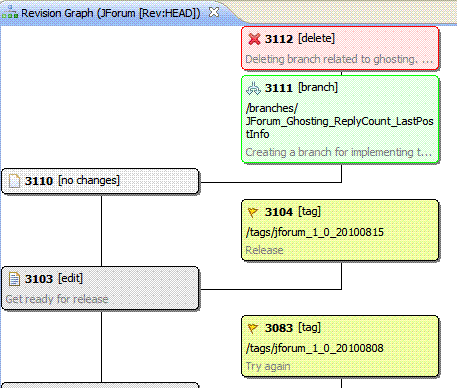
  • Revision Graph optional feature (see screenshot up top).  This was pretty much the only thing I switched to Tortoise SVN for and now it is in my main tool.  It is also easier to use than Tortoise’s version.  It has the following features:
    • Handles tags/branches/etc
    • If you mouseover a box, you see author, date and full commit comment
    • If you right click a box, you can compare to the trunk (which it calls ‘HEAD’ oddly enough), show history or branch/tag from that revision.
    • The image scrolls well.

What is still missing?

It’s still a pain to look at all the changes to a file.  This is something that is easy in CVS, but not SVN.  It is better than it was in the past release, but still a pain.  I recognize this is a number of operations in SVN, but it would be nice if a tool could automate it.  Since none of the other Subversion plugins have this feature either, I can’t call it a fault of Subversive though.

Comparison with Subclipse

In fairness to Subclipse, Subclipse also has an optional revision graph feature at this time.  Most of the logic from my previous post still applies.  I still like Subversive “just a bit better.”

What’s next?

I think the big question is whether Subversive will get promoted to actually be part of Eclipse.  It looks a lot more promising than 18 months ago.

—-

See my review of Eclipse 3.6 itself.

The LED Revolution

Unless you’ve been living in a cave, you may have noticed that LED light sources are now appearing in a number of devices, from pocket flashlights to laptops to televisions, primarily because they are cheaper to produce and tend to use less energy in devices than their non-LED counter-parts. In this article, I examine 3 new LED replacement technologies and evaluate whether or not the technology is mature enough to start replacing your non-LED devices.

 
I. LED Printers

In the home printing market, first there were dot matrix printers, followed by inkjet and laser printers, and now color LED printers. LED Printers use an array of LEDs as opposed to a laser to produce images from toner. They have fewer moving parts than most laser printers, making them more reliable, cheaper to produce, and possibly faster than conventional laser printers. They are even deemed safer to use due to the potential health concerns of laser printers. The only problem is print quality, which is currently limited to 600 DPI, whereas most laser printers can print 1200 DPI. This means images produced with LED printers may not be as sharp or high quality as those produced with laser printers.

The verdict: Once LED printers close the DPI gap, they will be positioned to replace laser in both home and business environments. Costs are still high for LED printers, but that’s expected to fall over time.

II. LED Televisions

Most people aren’t aware that there are light bulbs of any kind inside LCD TVs, referred to as backlight devices, which allow TVs to be viewed in pitch black rooms. Therefore, many novice shoppers often confuse the technology, comparing LED versus LCD televisions, despite the fact that both are actually LCD devices. The difference, then, is that LED TVs are LCD devices with LED’s for the backlighting, whereas what is commonly referred to as an LCD television is the same device but with a fluorescent light bulb providing the backlighting. The most obvious advantage is the depth or thickness of the TV, which can go from 4-5 inches to a remarkably thin 1 inch since LED bulbs are significantly thinner than fluorescent bulbs. The cost should be cheaper, although LED televisions are so new that they are often priced higher than their LCD counter parts. Finally, the power consumption and overall lifespan of the TV are improved, in part because there’s no fluorescent bulb to change. I’ve read dozens of television reviews that claim LED televisions have superior picture quality due to the fact that they have more even lighting, but after viewing them in person, I find the picture quality improvements are vastly theoretical. The biggest disadvantage of LED picture quality is the reduced viewing angle. If you’re looking at the TV from any angle other than directly in front of it, such as from the side or slightly above/below, the picture becomes extremely dark.

The verdict: Due to the reduced picture quality and the fact that LED televisions currently cost more than LCD, now is not the time to switch to LED. The thickness of the TV provides a bit of bragging rights, I’ll admit, but for now I’ll stick with improved picture quality and lower cost.

III. LED Light Bulbs

The most common light bulb we have all seen is the incandescent light bulb, which are now being replaced with compact fluorescent lamps that use far less power. While these two types of light bulbs each have their advantages and disadvantages, I’m reluctant to call one better than the other. A third type entering the market is LED light bulbs, which uses a cluster of small LEDs inside a shell to simulate a standard light bulb. The biggest advantage of these bulbs is significantly less power usage; since they don’t generate much heat, even more energy than is saved than with CFLs. The biggest disadvantages are the cost per bulb and weak ambient quality. Because LEDs create directed light, such as in a flash light, they perform poorly when use as an ambient light source such as a lamp or overhead room light.

The verdict: There is still a long way to go on LED light bulbs, both in terms of quality and price, which is right now quite expensive per bulb. While we’re still a long way off from replacing all the lights in our house with LED bulbs, the potential cost saving is astronomical. Granted, there are some previously unknown side effects of replacing lights with LED, such as this Wisconsin town found out, causing increased costs for snow cleaning crews.

Conclusion

The advantages of LED devices are pretty consistent: they use less power, are cheaper to produce, and often allow for smaller, lighter, and more compact form factors. One disadvantage is also pretty consistent, though: they tend to sacrifice quality. I suggest holding off jumping on the LED band-wagon until the technology has matured. There’s no doubt the prices of these devices and quality will improve, as manufacturers see lower costs equaling greater profits, but the technology just isn’t there for widespread adaptation. If you value quality over energy savings, you would do well to wait for the technology to catch up.