
First time at Oracle Code One! (second time if you count JavaOne!) This post will be updated over the next 4 days with links to all the posts while we’re here. We are also tweeting: Scott Selikoff and Jeanne Boyarsky
Big differences with the new name
Note: I only went to JavaOne once so I don’t know how much of this was specific to last year
- Signage
- No Duke cardboard cutout (but Duke still waddles around for pictures)
- Sunday community day is gone. But there is now a free Discover pass with access to the keynotes.
- That’s pretty much it. Great conference.
Monday
- Hands On Lab – DApps, Chaincode, Smart Contracts – Axel Bronder
- Tech Writing for Developers – Elloitte Rusty Harold
- Building Buletproof Java Enterprise applications – Sebastian Daschner
- Development Horror Stories – Roberto Cortez & Oleg Selajev
- Let’s make graph databases fun again in Java – Otavio Santana & Elder Moraes
- Continuous Delivery/DevOps Live Cooking Show – Michael Huttermann
- Better Software, Faster: Principles of Continuous Delivery and DevOps – Bert Jan Schrijver
- Keynote
Tuesday
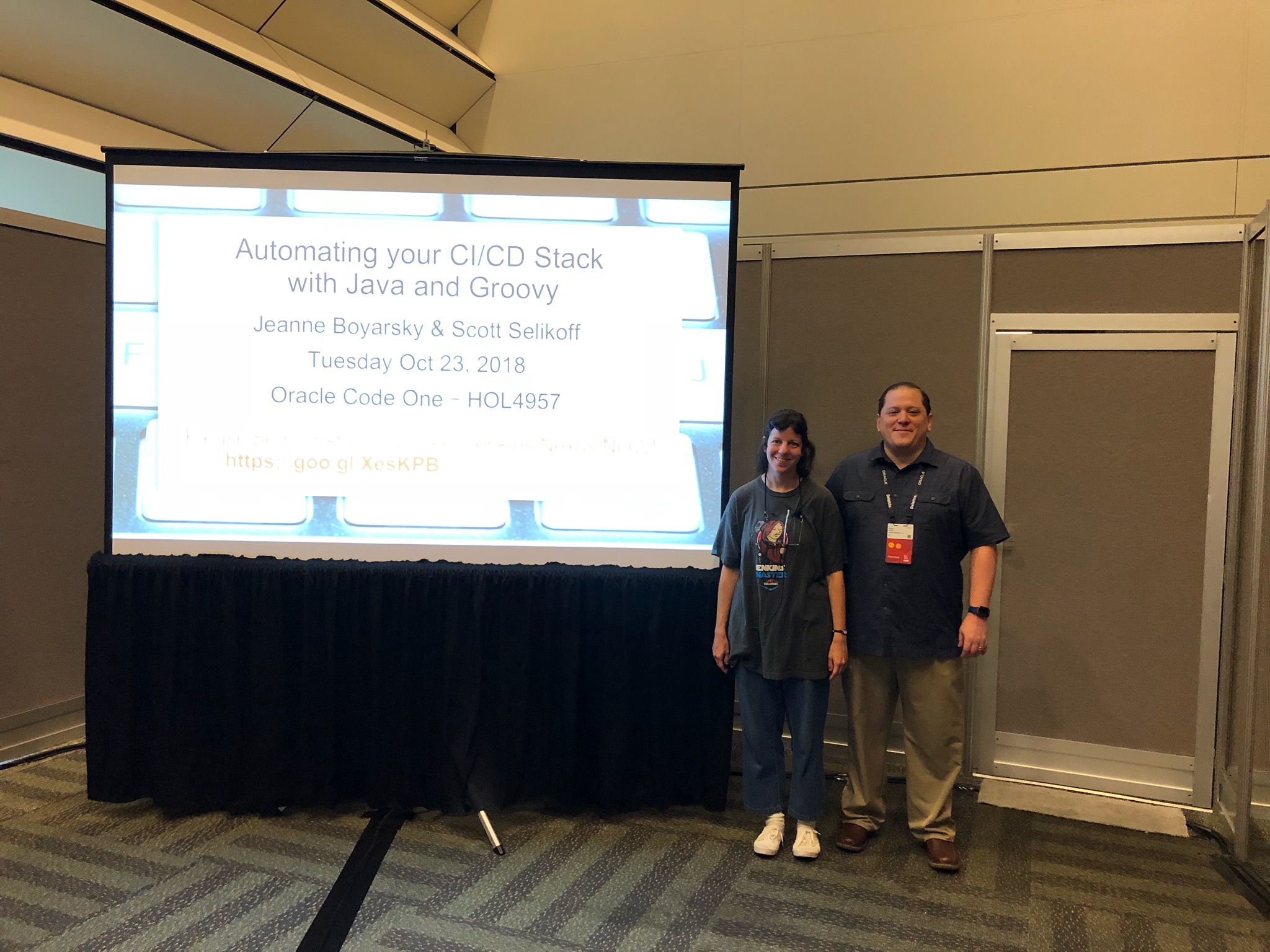
- Hands On Lab – Automating the CI/CD Stack with Groovy – Jeanne Boyarsky and Scott Selikoff (we were speaking so no blog; but there’s a link to the github repo)
- Var with Style – Stuart Marks
- You’re thinking too Classically – Tim Ellison
- Beyond git add/commit/push – Jorge Vargas and Victor Orozco
- DevSecOps: The Java Developer’s Guide to Automating with Groovy – Jeanne Boyarsky (speaking so just linking to the deck)
- Keynote – didn’t go. I was tired and needed a break between the above and the Ignite talk in the evening!
Wednesday
- Hands on lab – JNoSQL
- Evolutionary Architecture in Agile Environments – Xavier Rene-Corail
- PSA: java is Still Free – panel moderator by Steve Poole
- Which Java Version from which Vendor with what support? – Jeanne Boyarsky (speaking so just linking to the deck)
- Emerging Languages Bowl – Trisha Gee, Eugene Petrenko and Raghavan “Rags” Srinivas
- Keynote
Thursday
- The One Skill Developers Need to Design their Careers and Break the Career Plateau – Bruno “Javaman” Souza & Rodrigo Moutinho
- Augmented Reality for the Masses – Siamak Ashrafi
- Java 9/10/11: Pitfalls for the Unwary – Simon Ritter
- Mastering JPA Perforance – Thomas Broll
- Why JWTs Suck – Randall Degges
- Developing Java Applications with Visual Studio Code – Fred Bricon