
First of all, happy birthday. This is Eclipse’s tenth annual release train.
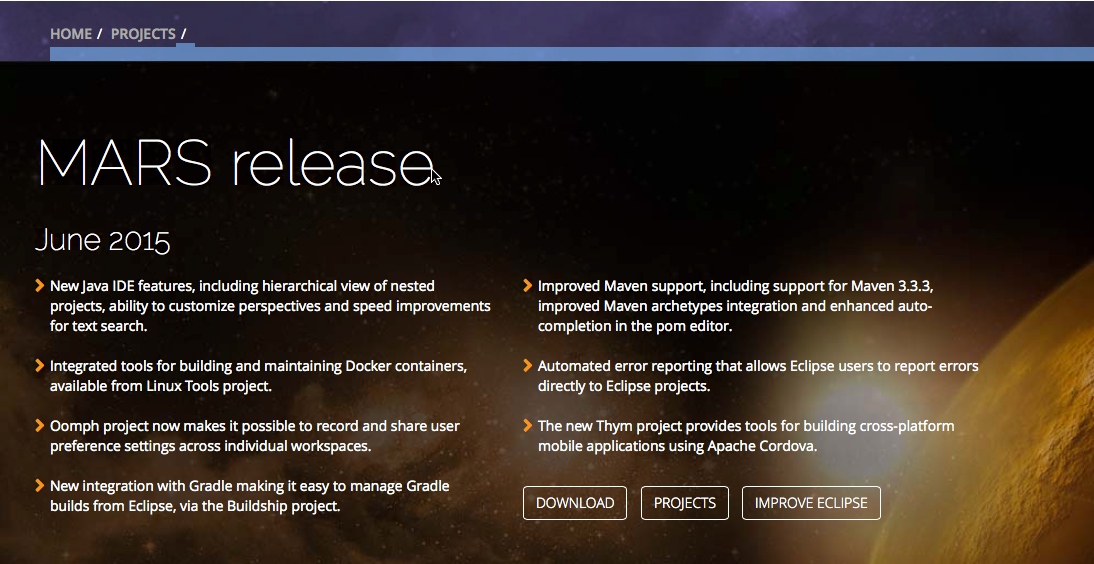
When I went to eclipse.org, I saw a nice picture of Mars. I have a choice of downloads including Java EE, Java and Spring Tool Suite. The matrix comparing the packages is still clear. I chose the Java EE version. The download page had a warning that “Eclipse requires Mac OS X 10.5 (Leopard) or greater.” No problem. I’m on the latest version. I’m also on the latest version of Java 8.
 The “tar” file (native app)
The first thing to notice is that Eclipse provides a tar file. Ok so that’s not new. What is new is that the tar file cannot be opened by the tar command because it contains absolute path names. And that Eclipse is now a native Mac app. This took me by surprise because I installed before looking at the docs.
More memory
Eclipse Mars uses more memory by default. Make sure you have enough before launching. I don’t expect to have problems with this.
To improve the “out of the box” user experience on today’s modern hardware, the default maximum heap size (-Xmx VM argument) has been increased from 512M to 1024M. And the initial heap size (-Xms) has been increased from 40M to 256M.
Initial launch
When launching my workspace, I got the warning:
Warning: Workspace ‘/myWorkspace’ was written with an older version of the product and will be updated. Updating the workspace can make it incompatible with older versions of the product. Are you sure you want to continue with this workspace.
Which is fine. I’m not going backward. And all the important code is in Subversion or Git anyway.
Installing the plugins
Like last year, I decided to install the plugins I need for Eclipse Marketplace so I can shed the plugins I tried out and don’t actually want. Cleaning plugin house once a year is nice.
The significant plugins I use are listed in this table. A number of plugins were beta for Luna or I had to use the Kepler version. I don’t remember that problem in previous years.
Last year, I tried out the Code Recommenders plugin. I didn’t install it this year as I hardly used it. I added Contrast and Bytecode Analyzer as plugins I installed in the past 12 months that I like. I also added ADT and tried out Optimizer for Eclipse by Zero Turn Around.
| Plugin | Purpose |
|---|---|
| Mongrel | Tomcat integration supporting recent versions of Tomcat. |
| Ecl Emma | Code coverage |
| PMD and FindBugs | Static analysis. For PMD, I had to use the update site. An install “happened” through Eclipse Marketplace, but I didn’t any of the PMD settings I was expecting. Using the update site gave me what I expected |
| Subversive | To access Subversion repositories |
| Groovy/Grails Tool Suite (didn’t install) | Groovy project/editor and console. At this time only the Luna version is available. But more Groovy/Grails support is native to Mars so it probably isn’t needed anymore as a separate plugin. |
| Eclipse Memory Analyzer | For finding memory leaks. Last year it was in Eclipse MarketPlace. The year before I needed to use the update site. This year we are back to using the update site. |
| Freemarker IDE | Freemarker syntax highlighting and macro assistance. Note that it is listed under the JBoss Tool Project. You pick that plugin and then unselect everything except “Freemarker IDE”. The JBoss Tool plugin was in beta on Mars release day. I installed this beta. |
| Python | Python plugin/perspective |
| Contrast | In the past 12 months, I installed the Contrast plugin for security. I like this one so re-installed it. See my impressions of the Contrast plugin. |
| Bytecode Outline | I’ve been looking at bytecode a good fit for the book to make sure I understand why things are happening. This plugin makes it easy. I first tried Bytecode Visualizer but install failed. (The website says there were 25 failed installs with the same dependency problem in the last 7 days). After installing Bytecode Outline, I realized this was the one I had installed for Luna anyway. |
| Android Development Tools | I have ADT as a separate install. It will be nice to be able to use my “main” Eclipse for that. |
| Optimizer for Eclipse | This is like a freeware ad for JRebel. I tried it out and it told me a couple things of interest like the heap size. And offered to clear my indexes which had been collecting for over a year. |
What excites me
- The JUnit view as a button to view only skipped tests. Awesome!
- The JUnit view now lets you re-run just one test in a parameterized test suite.
- The ability to close all tabs to the left or right of a current tab is cool.
- Search is faster on multi-core machines. I did notice a marginal improvement. I can’t tell if it was from this or from cleaning out my indexes.
- Quick assists between lambdas and method references
- When copying a file the new file is X2 instead of CopyOfX. Saves a few keystrokes per copy.
What I didn’t like
- I had troubles setting up Subversion connectivity, but did eventually get it to work.
- Since this install is on my home machine, I chose to enable error reporting. Eclipse asks me each time there is an error if I want to report it. I turned it off after reporting one error. It popped up to frequently and I have trouble imagining the dump has value to anyone. I was also annoyed they included my email in the HTML in the incident.
- I have a few launch configurations to run JUnit tests that I use regularly. When I ran each for the first itme, I got prompted for whether I wanted to use the Android JUnit or Java JUnit launchers. Not a big deal, but unexpected.
- I’m not thrilled about the native Mac application thing. The features/plugins directories are now in /Applications/Eclipse.app/Contents/Eclipse instead of a directory of my choosing. I’m also concerned about whether I’ll be able to have 4.4 and 4.5 on my machine concurrently in a year. Bear says you can have multiple versions installed.
Other interesting features
- Ctrl-Alt-B shortcut to skip all breakpoints. I don’t use breakpoints often so I don’t need a shortcut for this. It’s cool they created one though.
- There are said to be Maven updates including better autocomplete. I didn’t notice anything.
- Oomph for deploying Eclipse sounds like it has potential in a workspace environment
- A Java 9 experimental plugin It assumes have you have downloaded Java 9 which I haven’t already. I’m glad I won’t need to install a beta Eclipse when I’m ready to try out Java 9 though.